Four-Prong vs. Six-Prong Solitaire Security
Evaluating angular load sharing, Aurelia-style 6-prong cathedral geometry, claw thickness, and optical light clearance for round and fancy moissanites.
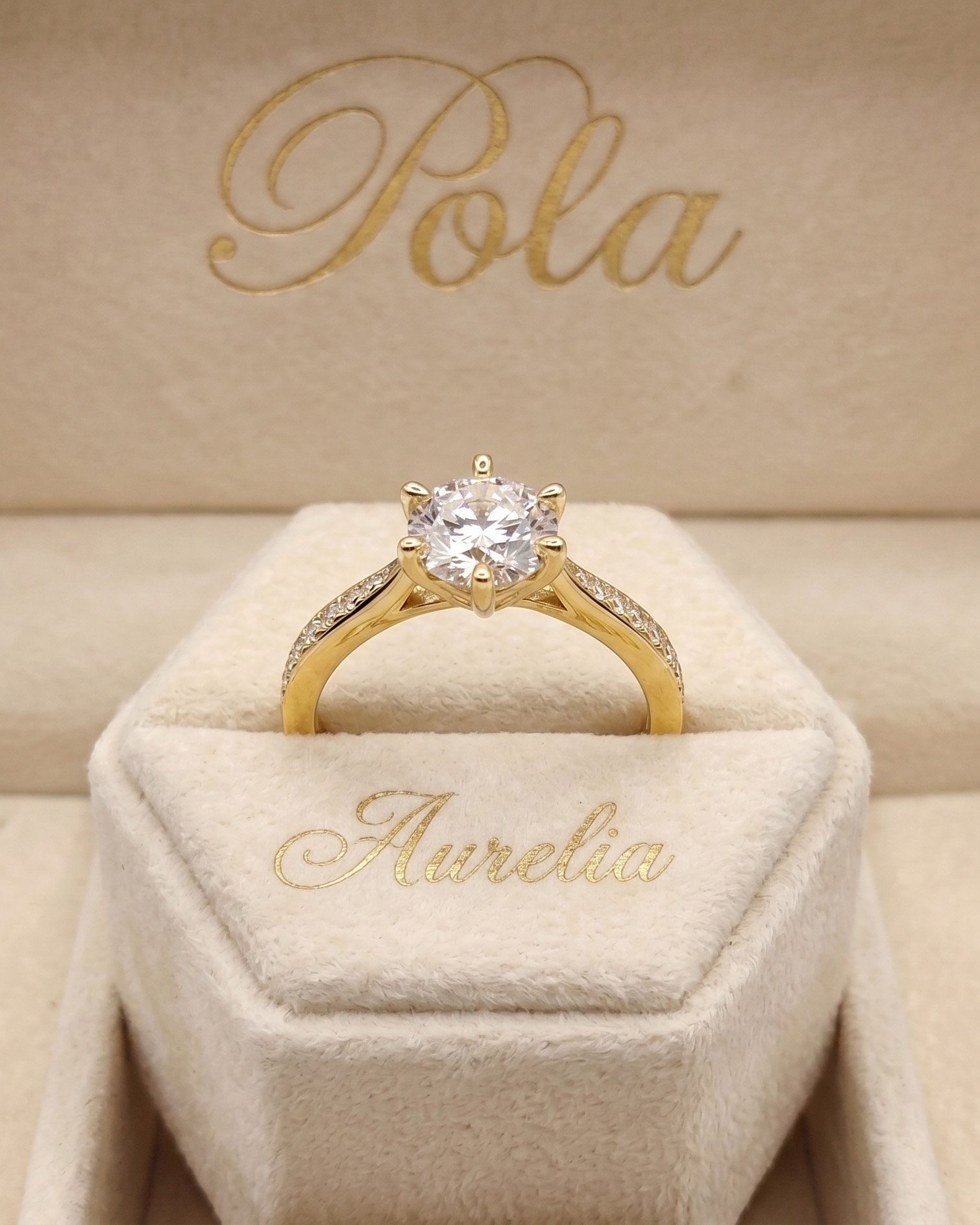
Evaluating angular load sharing, Aurelia-style 6-prong cathedral geometry, claw thickness, and optical light clearance for round and fancy moissanites.
A solitaire engagement ring is ultimately only as secure as the tiny metal talons gripping its girdle. One hard snag against wool sleeves, luggage zippers, or stone edges applies concentrated lever force directly onto prongs barely a millimeter wide.
Comparing a minimalist four-prong basket against a classic six-prong solitaire—exemplified by the Aurelia 6-prong cathedral silhouette—reveals vital differences in structural redundancy, visual roundness, and seasonal bench maintenance.
In a four-prong setting, claws sit at ninety-degree quadrants. If one corner catches a handle and bends outward by half a millimeter, the stone loses diagonal grip along a 180-degree axis and can twist free rapidly.
A six-prong basket places supports every sixty degrees. Even if a sharp impact lifts one talon, five neighboring prongs still trap over 240 degrees of the girdle, securing the moissanite safely until a jeweler tightens and retips the bent post.
Four-prong layouts naturally emphasize corners, framing a round stone in a subtly square outline with wide open sides. Six fine eagle-claw prongs reinforce circular symmetry, making a round Color D moissanite read cleanly round and slightly larger.
Physically, tapered 0.85–1.00 mm claw tips touch less than 4% of the outer girdle bevel. Thanks to silicon carbide's steep 2.65 refractive index, incoming light enters cleanly across the wide central table and crown facets without noticeable dimming.
Not every cut belongs in six round prongs. Step-cut emerald, square princess, and rounded cushion moissanites pair best with four crisp corner prongs—or double-claw corners above 2.50 ct DEW.
Pointed pear and marquise silhouettes need round side claws plus a notched V-tip prong shielding every sharp tip. Despite moissanite's 9.25 Mohs hardness and lack of cleavage, sharp 30-degree points still deserve solid V-cap impact armor.
Structural and optical comparison across common engagement basket styles.
| Setting Parameter | 4-Prong Basket | 6-Prong Aurelia-Style Crown | Double-Claw / V-Tip Hybrid |
|---|---|---|---|
| Angular Spacing | 90° Quadrants | 60° Hexagonal Symmetry | Corner-Matched + V-Cap |
| Single-Prong Failure Risk | High (Diagonal Escape Path) | Low (5 Prongs Retain Stone) | Very Low on Corners/Points |
| Face-Up Shape Effect | Subtly Squarish Framing | Accentuates True Roundness | Highlights Elongated Angles |
| Best Cut Pairings | Emerald, Cushion, Radiant, Oval | Round Brilliant (6.5 mm+) | Pear, Marquise, Large Oval |
| 925 Silver Compatibility | Needs Thick 1.1 mm Wires | Strong Lateral Basket Stiffness | Ideal for Larger Fancy Centers |
| Snag & Cleaning Access | Wide Open Side Brush Access | Slight Extra Brush Around Ribs | Inspect V-Tip Pockets Monthly |
Bulky, poorly cast dome beads from cheap factories obscure small stones, causing buyers to blame prong count instead of sloppy bench carving.
Hand-filed eagle-claw tips taper to sharp points at the outer girdle bevel—locking the stone at six points while letting Color D fire erupt across the table.
Ultra-cheap cast rings cut corners with hollowed, porous 4-prong heads and soft untempered tips that peel under fingernail pressure. If you hear a faint click when tapping your stone gently with a wooden toothpick, stop wearing it for immediate tightening.
Watch out for sub-$50 / sub-200 PLN silver rings: The same caution applies to discount online boutiques and resellers offering sterling silver moissanite rings for less than $50 (or under 200 PLN in European markets)—almost invariably inexpensive Asian mass-market builds set with weaker warm-tinted or imprecise stones.
Inspect Aurelia-inspired six-prong cathedral engagement rings set exclusively with certified Color D / VVS1 moissanite crystals.