Moissanite vs. Natural Diamond: Seven Defining Traits
A side-by-side optical, mineralogical, and budget investigation separating 4H silicon carbide from natural crystalline carbon.
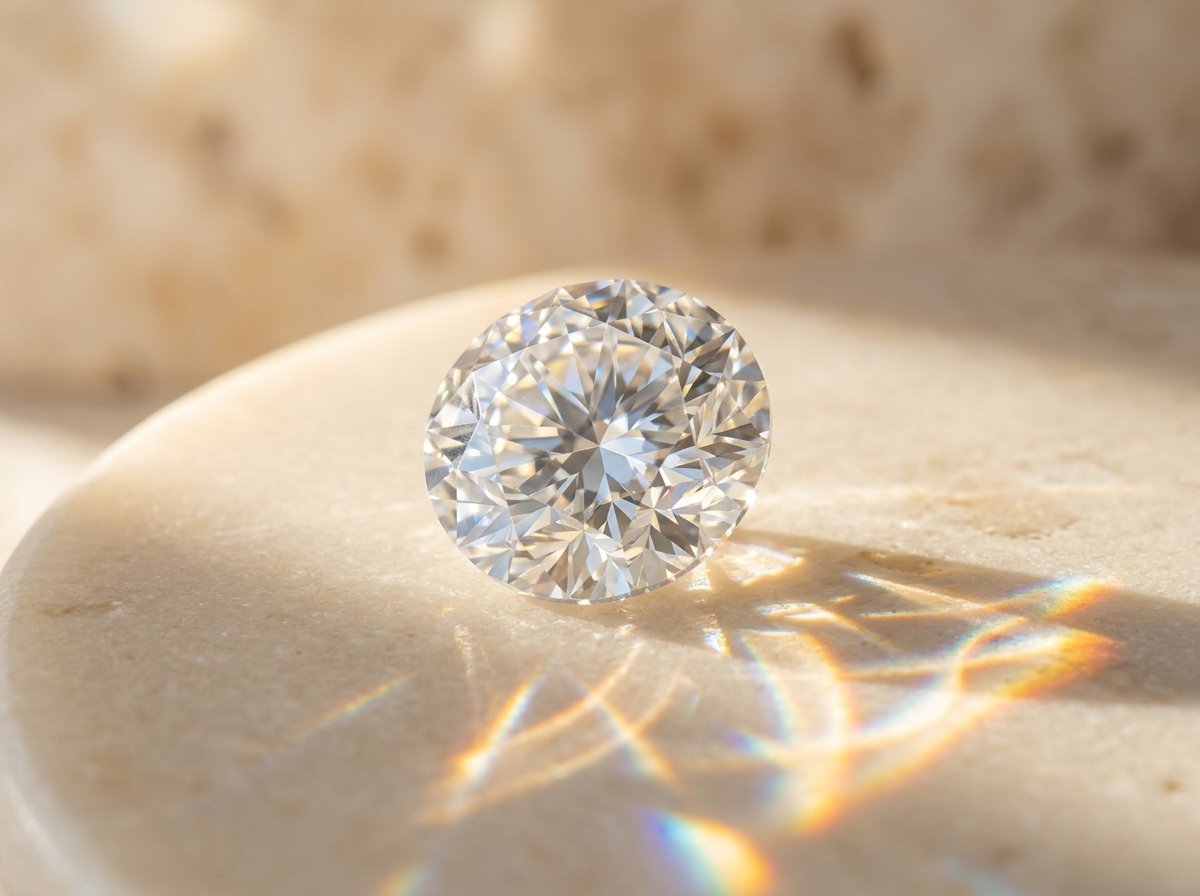
A side-by-side optical, mineralogical, and budget investigation separating 4H silicon carbide from natural crystalline carbon.
Despite frequent market shorthand calling moissanite a 'diamond alternative,' gemology classifies silicon carbide (4H-SiC) as an entirely separate crystal species with its own atomic symmetry, optical anisotropy, and thermal physics. Comparing the two stones begins with moving past look-alike assumptions toward measurable optical constants.
Whether evaluating a classic solitaire engagement setting or selecting precision-cut anniversary stones, seven concrete laboratory metrics explain why modern buyers gravitate toward optically calibrated Color D / VVS1 silicon carbide.
Diamond consists of pure carbon atoms arranged in an isometric cubic crystal system, resulting in single-refractive optical isotropy. Natural terrestrial diamonds crystallize hundreds of kilometers beneath Earth's crust over billions of years.
First identified by Henri Moissan inside meteorites in 1893, moissanite is silicon carbide—strictly covalent Si–C tetrahedra grown today via modified Physical Vapor Transport (PVT). Its hexagonal 4H-SiC stacking unlocks wide-bandgap clarity at Color D alongside zero mining footprint.
Two measurements govern eye-catching sparkle: Refractive Index (light slowing and bending efficiency) and Spectral Dispersion (splitting white light into rainbow wavelengths). Moissanite outperforms diamond on both fronts.
Because hexagonal 4H-SiC is optically anisotropic, a ray passing down off-axis pavilion paths splits into two polarized beams traveling at slightly different speeds. Under a 10x triplet loupe angled slightly off the crown axis, pavilion facet junctions display clean double lines—an instant gemological giveaway separating moissanite from single-refractive diamond or cubic zirconia.
Diamond crowns the Mohs hardness scale at 10.0, while moissanite follows immediately behind at 9.25—outscoring corundum sapphires and rubies (9.0) and leaving soft cubic zirconia (8.0–8.5) far behind. Critically, moissanite lacks weak octahedral cleavage planes, giving girdle rims remarkable impact resilience in active everyday jewelry.
Silicon carbide's density (3.22 g/cm³) runs ~9–10% lighter than diamond (3.52 g/cm³). A round moissanite cut to an exact 6.50 mm diameter looks visually identical in face-up diameter to a 1.00 ct round diamond—yet registers roughly 0.88–0.90 ct on a physical carat scale. Jewelry houses standardize diameter under Diamond Equivalent Weight (DEW).
Traditional pen testers measure thermal conductivity alone—meaning genuine 4H-SiC triggers the 'Diamond' signal reliably. Because pure Color D silicon carbide behaves as a wide-bandgap semiconductor (~3.26 eV), dual thermal-and-electrical probes separate both stones instantly within a single second.
An unmounted, certified Color D / VVS1 1.00 ct DEW moissanite trades around $32 USD (~120 PLN), whereas a visually comparable GIA Color D / VVS1 mined diamond often exceeds $5,900+. Choosing calibrated Color D crystals avoids conflict-supply opacity and reserves capital without surrendering heirloom permanence.
Measured laboratory values contrasting 4H-SiC moissanite against mined diamond and mass-market cubic zirconia.
| Property | Moissanite (4H-SiC) | Natural Diamond (C) | Cubic Zirconia (ZrO₂) |
|---|---|---|---|
| Chemical Formula | Silicon Carbide (SiC) | Crystalline Carbon (C) | Zirconium Dioxide (ZrO₂) |
| Refractive Index (RI) | 2.65 – 2.69 | 2.42 | 2.15 |
| Spectral Fire (Dispersion) | 0.104 (Highest) | 0.044 | 0.060 |
| Mohs Scratch Hardness | 9.25 / 10 | 10.0 / 10 | 8.0 – 8.5 / 10 |
| Optical Refraction Type | Birefringent (Double) | Isotropic (Single) | Isotropic (Single) |
| Specific Gravity | 3.22 g/cm³ (DEW scaled) | 3.52 g/cm³ | 5.6 – 6.0 g/cm³ |
| Heat Tester Response | Passes as Diamond | Passes as Diamond | Fails (Simulant) |
Cubic zirconia is zirconium oxide with soft 8.0–8.5 hardness and lower RI (2.15) that abrades and turns cloudy after months of wear.
Rigid covalent 4H silicon carbide ranks 9.25 Mohs with zero surface porosity—retaining knife-sharp facets and higher brilliance than diamond indefinitely.
Online bargain platforms often list warm G–J rejects, poor off-angle cuts, or coated zirconia as “Color D / VVS1” alongside photocopied GRA booklets. Without optical screening, low-grade rough visibly dims under soft indoor lighting.
Watch out for sub-$50 / sub-200 PLN silver rings: The same caution applies to discount online boutiques and resellers offering sterling silver moissanite rings for less than $50 (or under 200 PLN in European markets)—almost invariably inexpensive Asian mass-market builds set with weaker warm-tinted or imprecise stones.
Biżuteria Pola sets strictly verified optical Color D / VVS1 moissanite (zero warm E–I lots) crafted for fine daily wear and lifetime brilliance.