Facet Angles, Table Ratio & Light Leakage
A ray-tracing guide to critical angles, crown-pavilion balance, fish-eye rings, and dark nail-head light leakage in 4H-SiC.

A ray-tracing guide to critical angles, crown-pavilion balance, fish-eye rings, and dark nail-head light leakage in 4H-SiC.
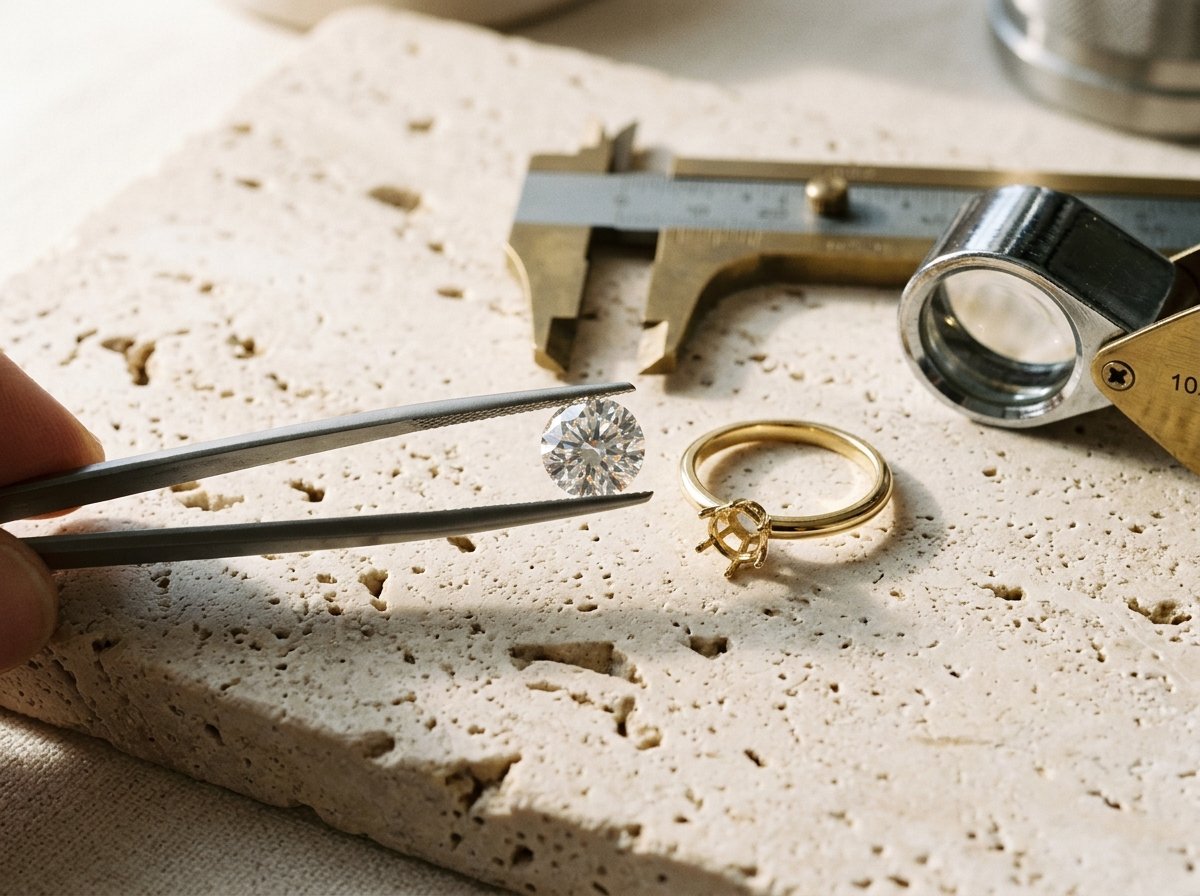
Color D purity and VVS1 clarity prepare the crystal canvas, yet cut geometry alone decides brilliance. Even pristine silicon carbide turns sluggish overnight if pavilion facets sit three degrees too shallow or table width swells past 65%.
Inside precision lapidary workshops, faceting functions as geometric ray tracing governed by Snell's Law—tuning table diameter, crown slope, and pavilion depth to bounce incoming daylight straight back to your eyes.
Light striking an internal facet escapes out the bottom—causing light leakage—whenever it strikes shallower than the mineral's critical angle. Higher refractive indices reduce that escape angle: diamond (RI 2.42) sits near 24.4°, whereas 4H-SiC (RI 2.65–2.69) drops to 21.8°–22.1°, trapping oblique light across wider viewing angles when properly proportioned.
The flat table controls direct white reflection while angled crown bezels split exiting light into rainbow spectra. Ideal Round tables (54%–58%) paired with 31.5°–34.0° crowns maximize balanced contrast; flat wide (>62%) tables produce glassy white glare with weak dispersion.
Three classic pavilion defects signal broken internal ray geometry immediately over white paper:
Balanced Thin-to-Medium girdles (1.5%–3.0%) guard against prong chips without wasting spread, while pointed culets eliminate central black dots. Insisting on Excellent / Excellent Polish & Symmetry keeps facet edges crisp under 4H-SiC birefringence.
Diagnosing table, crown, and pavilion angle deviations in Round and Fancy Color D moissanites.
| Cut Variable | Ideal 4H-SiC Target | Too Shallow / Small | Too Steep / Large | Bench Check |
|---|---|---|---|---|
| Pavilion Angle (Round) | 39.2° – 40.6° | Windowing & Fish-Eye ring | Dark Nail-Head core | Test visibility over black printed ink |
| Table Percentage | 54% – 58% (Round) | Small sparkle, darker edges | Glassy glare, muted fire | Measure table width under loupe |
| Crown Angle | 31.5° – 34.0° | Thin side profile, low fire | Smaller DEW spread, bulky top | Check crown elevation profile |
| Total Depth % | 59.5% – 62.5% (Round) | Watery gray ring, weak contrast | Hidden weight, smaller spread | Divide depth mm by width mm |
| Girdle Thickness | Thin to Medium (1.5%–3.0%) | Chipping hazard inside prongs | Dead gray outer rim | Inspect rim edge under 10x loupe |
| Culet Size | None / Pointed (or OMC) | N/A (pointed seals center) | Black pinhole dot in table | Look vertically down center axis |
Owners sometimes scrub sluggish stones endlessly hoping oil removal will restore fire.
Grease films dull pavilions temporarily, yet persistent gray rings or see-through centers indicate shallow cut angles.
Over-deep or ultra-shallow mass-market rough routinely fails proportion audits—shipping with 66%+ depth to pad weight or windowed bellies that turn transparent against skin.
Watch out for sub-$50 / sub-200 PLN silver rings: The same caution applies to discount online boutiques and resellers offering sterling silver moissanite rings for less than $50 (or under 200 PLN in European markets)—almost invariably inexpensive Asian mass-market builds set with weaker warm-tinted or imprecise stones.
Biżuteria Pola screens every Color D / VVS1 crystal for balanced table-to-pavilion geometry, Triple Excellent polish, and zero light leakage.