Moissanite vs. White Sapphire: Why Corundum Looks Flat
Exploring critical angles, 0.104 vs. 0.018 dispersion, grayed-out windowing, and oil sensitivity in colorless Al₂O₃ versus 4H-SiC.
Exploring critical angles, 0.104 vs. 0.018 dispersion, grayed-out windowing, and oil sensitivity in colorless Al₂O₃ versus 4H-SiC.
Traditional jewelry buyers seeking a natural, mined colorless gem without diamond pricing frequently turn to white sapphire—colorless crystalline aluminum oxide (Al₂O₃). Because sapphire shares a prestigious heritage and strong 9.0 Mohs durability, many expect its visual performance to mirror colorless diamonds or moissanite.
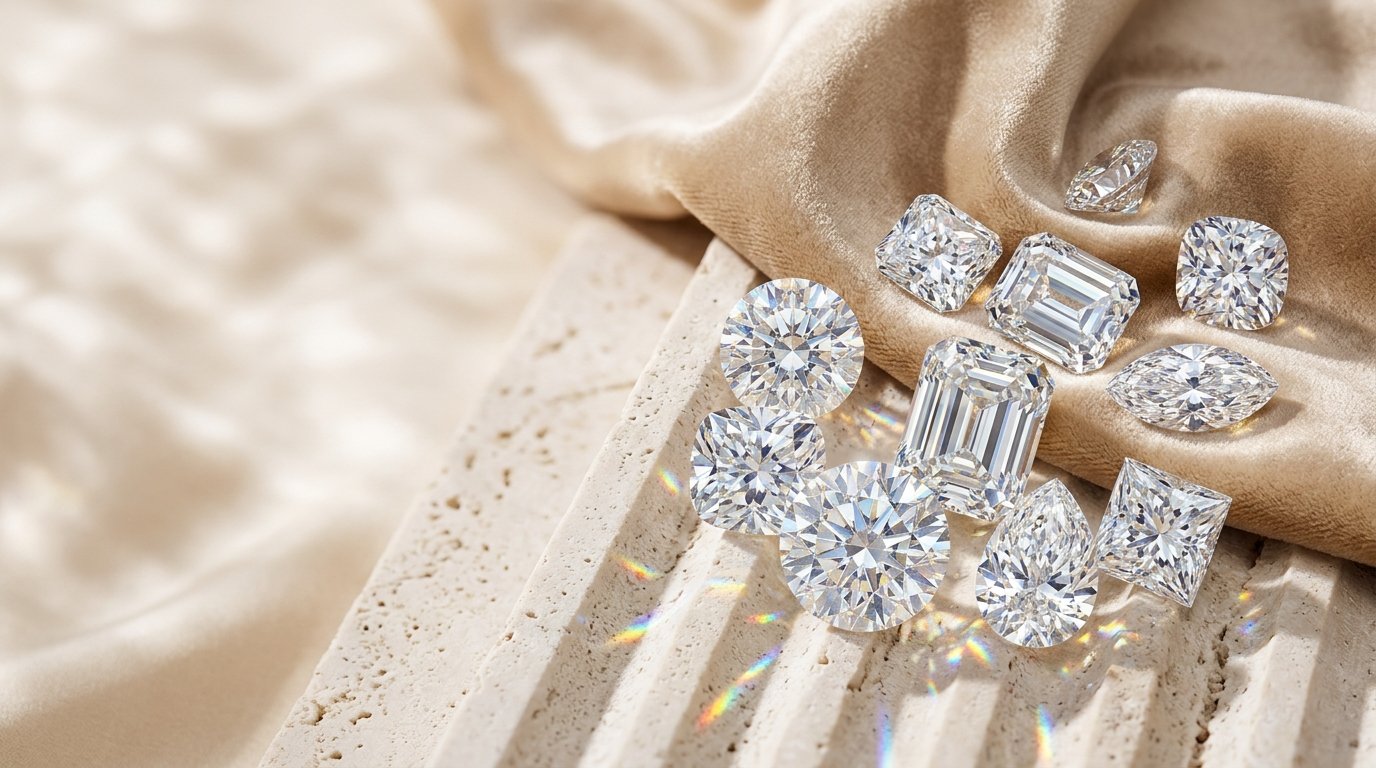
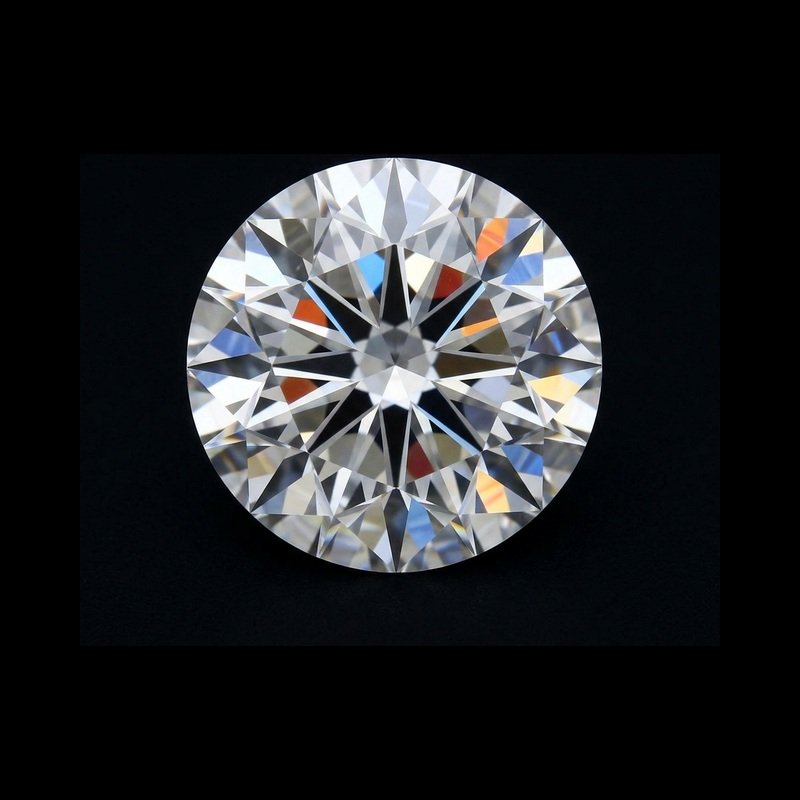
Side by side on a jeweler's tray, however, the contrast is immediate and unmistakable. Even under bright boutique spotlights, white sapphire delivers subdued, watery luster and frequent gray shadow windows, while optically pure Color D 4H-SiC moissanite radiates electric crispness across every facet.
A gemstone shines only when rays entering through the crown bounce off pavilion facets via Total Internal Reflection (TIR) and return to the viewer's eye. That threshold depends directly on refractive index: the critical angle equals arcsin(1 / RI).
For white sapphire (RI 1.765), any photon striking a pavilion facet steeper than 34.5° escapes straight out the back of the stone, creating an empty see-through patch ('windowing') that reveals skin or dark ring metal underneath. Moissanite's extreme 2.65–2.69 RI tightens the critical angle to 22.2°—capturing off-axis light across nearly the entire pavilion dome.
White sapphire's dispersion coefficient measures just 0.018—less than half of diamond (0.044) and nearly six times weaker than moissanite (0.104). Consequently, colorless corundum reflects largely white, low-contrast flashes devoid of vivid prismatic fire.
Both white sapphire and moissanite excel in permanent everyday engagement rings. Neither mineral exhibits true cleavage, though repeated thermal shock or sharp blows can trigger minor basal parting along twin planes in corundum.
Moissanite holds a slight scratch-hardness edge (9.25 vs. 9.0 Mohs), providing additional resistance against silicon carbide workshop abrasives or ceramic surfaces while avoiding the high cost per millimeter of eye-clean natural white sapphires over 1.50 carats.
Eye-clean natural white sapphires above 1.50 ct command $800–$2,500+ USD yet deliver visibly muted brilliance. Flame-fusion synthetic white sapphire costs pennies per carat yet retains identical low-RI flatness. For roughly $32–$58 USD loose in 1.00–2.50 ct DEW, Color D moissanite outperforms corundum across brilliance, spread per carat, and spectral life.
Measured laboratory constants illustrating why corundum appears more subdued than 4H-SiC.
| Property | Moissanite (4H-SiC) | White Sapphire (Al₂O₃) |
|---|---|---|
| Refractive Index (RI) | 2.65 – 2.69 | 1.76 – 1.77 |
| Critical Angle (in air) | ~22.2° (High light trap) | ~34.5° (Prone to windowing) |
| Spectral Dispersion | 0.104 (Vivid fire) | 0.018 (Minimal fire) |
| Mohs Scratch Hardness | 9.25 / 10 | 9.0 / 10 |
| Specific Gravity | 3.22 g/cm³ | 4.00 g/cm³ (Smaller mm per ct) |
| Color Neutrality | True Optical Color D available | Often faint gray/silky unless treated |
| Oil-Film Tolerance | High optical margin | Dims rapidly under sebum/lotions |
| 1.0 ct Visual Presence | 6.5 mm DEW (~$32 loose) | ~5.9 mm physical 1 ct ($400–$1,200 natural) |
Because sapphire sits just below diamond on the Mohs scale (9 vs. 10), shoppers often assume its optical brilliance ranks just below diamond as well.
At 1.77 RI and 0.018 dispersion, white sapphire delivers less than half the fire of diamond and shows wide gray light windows—whereas 4H-SiC surpasses diamond's brilliance at 2.65–2.69 RI.
Some ultra-low-cost online boutiques advertise 'white sapphire' or 'D-grade moissanite' under $50 while shipping flame-fusion synthetic spinel or glassy CZ. Verify GRA laser serials or test refractive reflection before mounting.
Watch out for sub-$50 / sub-200 PLN silver rings: The same caution applies to discount online boutiques and resellers offering sterling silver moissanite rings for less than $50 (or under 200 PLN in European markets)—almost invariably inexpensive Asian mass-market builds set with weaker warm-tinted or imprecise stones.
Discover loose and set optical Color D / VVS1 crystals curated by Biżuteria Pola—delivering crisp mirror brilliance across every millimeter without the flat grey tone of colorless sapphire.