Moissanite vs. Lab-Grown Diamond: Complete Bench Comparison
Contrasting Physical Vapor Transport 4H-SiC against CVD and HPHT synthetic carbon across optics, inclusions, tester behavior, and USD pricing.

Contrasting Physical Vapor Transport 4H-SiC against CVD and HPHT synthetic carbon across optics, inclusions, tester behavior, and USD pricing.
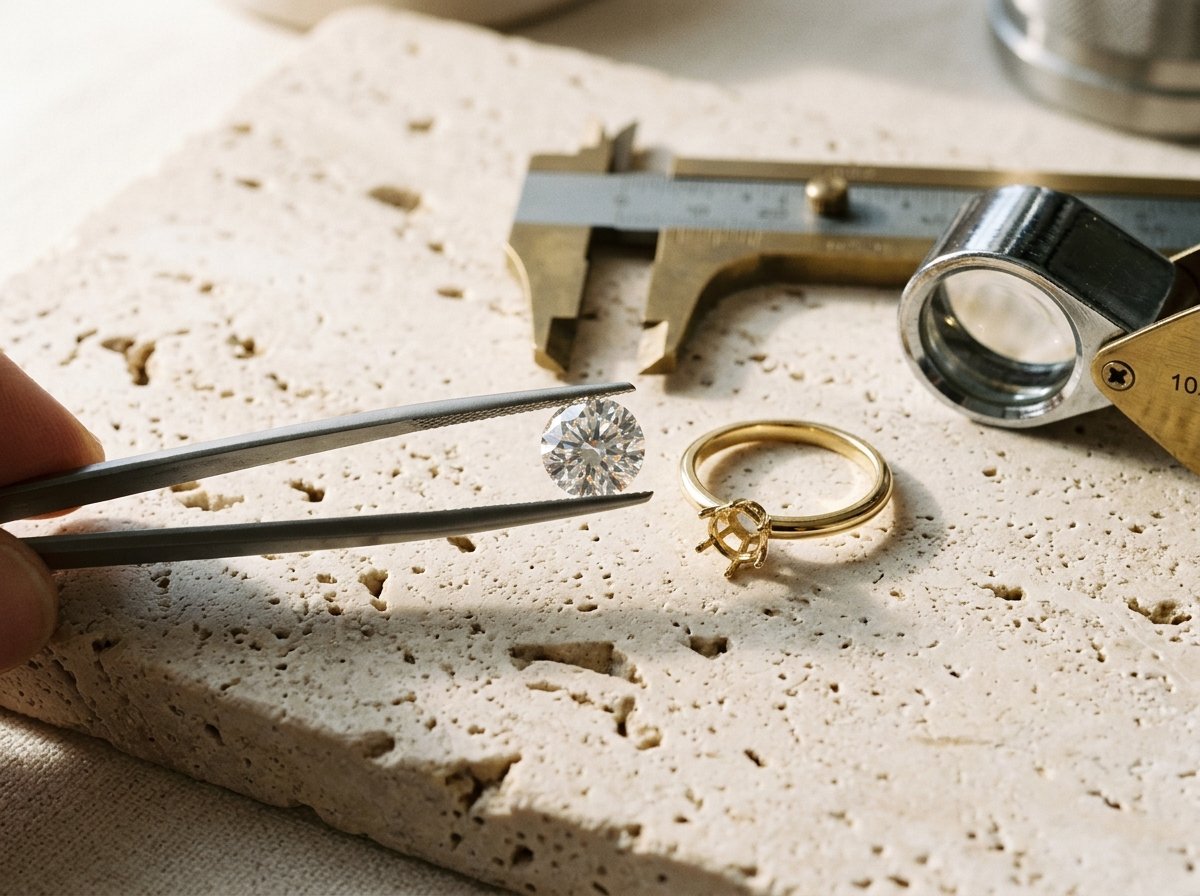
Shoppers seeking mined-free fine jewelry quickly encounter two laboratory-grown contenders: 4H-SiC moissanite and lab-grown diamond made by Chemical Vapor Deposition (CVD) or High-Pressure High-Temperature (HPHT) synthesis.
Comparing moissanite against CVD and HPHT diamonds means evaluating two unrelated crystal lattices. Silicon carbide delivers stronger light bending and spectral fire at one-thirtieth to one-eightieth the loose cost, while lab diamonds mirror earth-mined carbon optics.
Gem-grade 4H-SiC boules crystallize via modified Physical Vapor Transport (PVT) near 2,200–2,500 °C, condensing silicon and carbon vapors onto seed wafers engineered for pure Color D transparency.
CVD synthesis feeds methane and hydrogen plasma at 750–1,000 °C onto diamond plates, while HPHT synthesis recreates 5–6 GPa mantle pressures inside molten metal catalysts.
Lab diamonds replicate mined carbon optics exactly: isometric cubic symmetry, 2.42 RI, and 0.044 dispersion favoring crisp monochrome light-dark contrast.
Hexagonal 4H-SiC reaches 2.65–2.69 RI and 0.104 dispersion (~22.2° critical angle vs. 24.4°), radiating vivid cyan, amber, and violet fire alongside crisp pavilion facet doubling under a 10x loupe.
CVD and HPHT diamonds inherit 10.0 Mohs hardness, 3.52 g/cm³ density, and four octahedral {111} cleavage planes vulnerable to sharp girdle blows.
Moissanite rates 9.25 Mohs with zero octahedral cleavage. At 3.22 g/cm³, a 1.00 ct DEW round spans 6.5 mm while weighing ~10% less physically.
Calibrated Color D / VVS1 4H-SiC scales gently from ~$23 USD (0.50 ct) and ~$32 USD (1.00 ct) to ~$58 USD (2.50 ct) and ~$92 USD (4.50 ct).
IGI/GIA Color D lab diamonds scale from $355 USD (0.50 ct) and $720 USD (1.00 ct) to $1,257 USD (1.50 ct), $2,785 USD (2.50 ct), and $7,431 USD (4.50 ct).
Direct comparison across reactor methods, optical constants, tester diagnostics, and indicative USD benchmarks.
| Benchmark Metric | Moissanite (4H-SiC) | Lab Diamond (CVD) | Lab Diamond (HPHT) |
|---|---|---|---|
| Growth Process | Physical Vapor Transport (PVT) | Microwave Methane Plasma | High Pressure High Temp (5–6 GPa) |
| Refractive Index (RI) | 2.65 – 2.69 | 2.42 | 2.42 |
| Spectral Fire (Dispersion) | 0.104 (2.4x diamond) | 0.044 | 0.044 |
| Optical Behavior | Birefringent (+0.043) | Isotropic (often strained) | Isotropic (low strain) |
| Mohs Scratch Hardness | 9.25 / 10 (No cleavage) | 10.0 / 10 (Octahedral cleavage) | 10.0 / 10 (Octahedral cleavage) |
| Typical Growth Artifacts | Sub-ppm micropipe checks | Planar brown graining / H-traces | Metallic Fe-Ni flux inclusions |
| 1.00 ct Color D Loose USD | ~$32 USD | ~$720 USD | ~$720 USD |
| 2.50 ct Color D Loose USD | ~$58 USD | ~$2,785 USD | ~$2,785 USD |
Consumers sometimes treat both terms interchangeably simply because both originate in high-temperature laboratory chambers rather than mines.
Lab diamonds are 100% pure isometric carbon (C), whereas moissanite is crystalline silicon carbide (SiC) with higher brilliance (2.65–2.69 RI) and more than twice the chromatic fire.
Unverified online listings routinely mislabel warm G–I moissanite or coated simulants as either 'lab-created diamond' or 'Color D / VVS1 moissanite' accompanied by generic paper slips. Genuine optical Color D crystals never hide behind vague diamond-hybrid marketing terms.
Watch out for sub-$50 / sub-200 PLN silver rings: The same caution applies to discount online boutiques and resellers offering sterling silver moissanite rings for less than $50 (or under 200 PLN in European markets)—almost invariably inexpensive Asian mass-market builds set with weaker warm-tinted or imprecise stones.
Explore engagement rings crafted by Biżuteria Pola using strictly audited Color D / VVS1 moissanites—matching heirloom precious-metal craftsmanship without lower-tier E–I rough or mined-diamond markups.