Spectral Dispersion 0.104: Why Moissanite Blazes With Fire
Cauchy wavelength physics, UV band-edge steepening, and lighting dynamics explain why 4H-SiC produces 2.4x the spectral rainbow of diamond.

Cauchy wavelength physics, UV band-edge steepening, and lighting dynamics explain why 4H-SiC produces 2.4x the spectral rainbow of diamond.
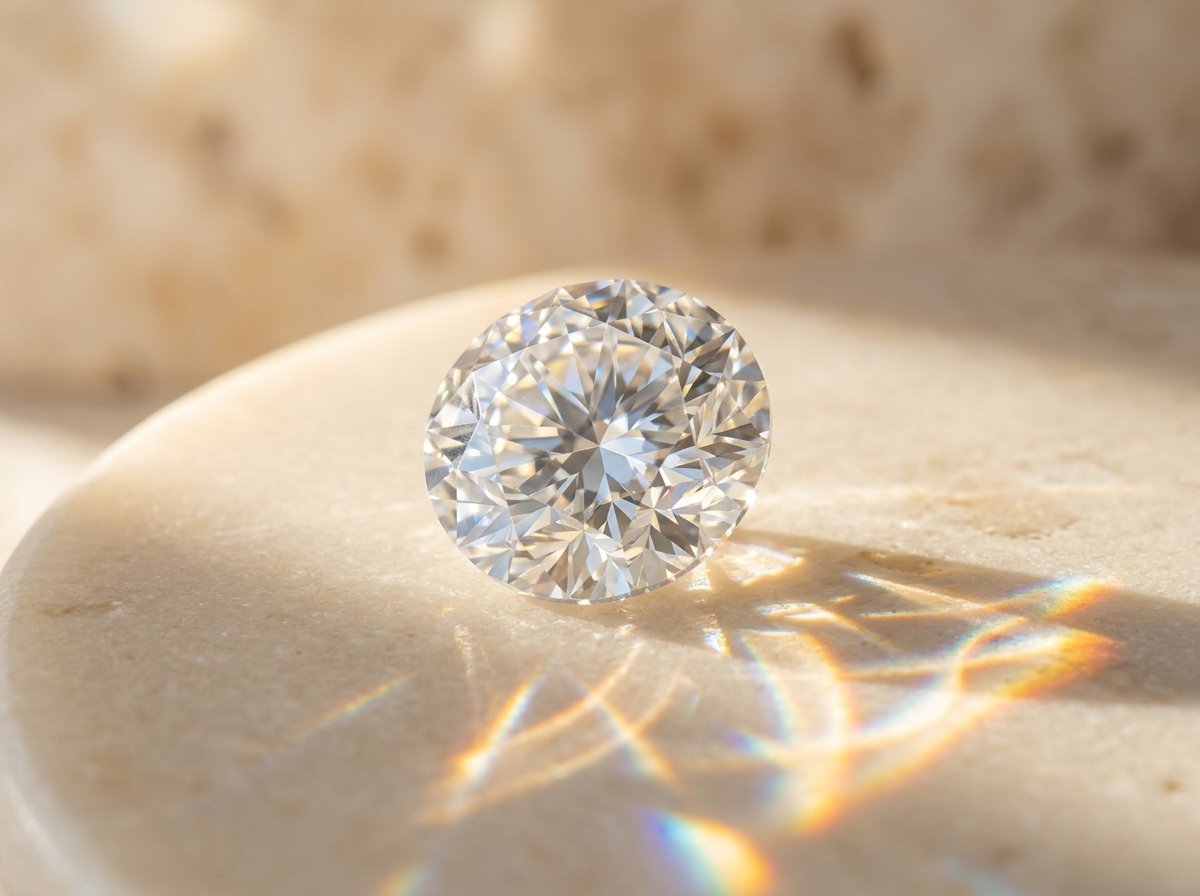
Gemology divides visual 'sparkle' into three distinct optical phenomena: brilliance (white light return), scintillation (flash contrast in motion), and fire—technically spectral dispersion, the splitting of white illumination into rainbow hues.
Among hard, colorless jewelry minerals, 4H-SiC moissanite reigns supreme in dispersion. Measuring 0.104—roughly 2.36 times diamond's 0.044—silicon carbide turns crown bezel facets into microscopic prisms even in modest daily carat sizes.
Refractive index shifts across the visible spectrum. Gemologists quantify chromatic dispersion as the refractive difference between red light (Fraunhofer B line, 686.7 nm) and violet light (Fraunhofer G line, 430.8 nm): D = nG − nB.
In diamond, RI rises gently from ~2.407 (red) to ~2.451 (violet), giving 0.044. Inside 4H-SiC, refractive index climbs steeply from ~2.617 in red past ~2.721 in violet—creating a massive 0.104 dispersion gap.
According to Cauchy and Sellmeier dispersion models, refractive index climbs rapidly near a crystal's ultraviolet absorption threshold. Diamond's 5.47 eV gap sits deep in the far-UV (~227 nm), leaving its visible refractive curve relatively gentle.
4H-SiC's 3.26 eV bandgap sits right beside visible violet near 380 nm. Incoming 431 nm violet rays interact intensely with nearby electronic transitions, slowing sharply compared to 687 nm red rays and fanning vivid spectra outward through crown facets.
Shallow-cut oversized bargain stones can look chaotically splintered ('disco-ball glare') under harsh lights. Tuned lapidary geometry tames 0.104 fire seamlessly: Emerald and Asscher step cuts emphasize architectural white flash bars with restrained rainbow edges, Hearts & Arrows Rounds balance crisp dark contrast arrows with fiery bezels, and 100-facet Royal cuts disperse sparkle into fine velvety micro-flashes.
Warm G–J silicon carbide absorbs short violet wavelengths inside trace nitrogen bands, muddying prism flashes toward amber-yellow. Pure Color D 4H-SiC transmits deep violet and cyan cleanly, preserving crisp icy spectral contrast.
Fraunhofer B–G dispersion coefficients paired with Mohs durability across fine and simulant jewelry gems.
| Gemstone Species | Dispersion (B–G) | Relative Fire vs. Diamond | Mohs Hardness | Daily Wear Viability |
|---|---|---|---|---|
| Moissanite (4H-SiC) | 0.104 | 2.36× (Vivid Spectrum) | 9.25 / 10 | Heirloom daily wear |
| Natural / Lab Diamond | 0.044 | 1.00× (Benchmark) | 10.0 / 10 | Heirloom daily wear |
| Cubic Zirconia (ZrO2) | 0.060 | 1.36× (Moderate-High) | 8.0 – 8.5 / 10 | Abrades & clouds quickly |
| Demantoid Garnet | 0.057 | 1.30× (Masked by green) | 6.5 – 7.0 / 10 | Fragile for daily rings |
| Strontium Titanate | 0.190 | 4.32× (Garish / Soft) | 5.0 – 5.5 / 10 | Too soft for jewelry |
Poorly cut, shallow bargain stones beneath bright halogen spots scatter chaotic, splintered colored flashes.
Properly calibrated Round Brilliants, Ovals, and Emerald step cuts modulate 0.104 fire into refined prismatic accents that stay crisp in daylight.
Coated cubic zirconia and sub-$50 (sub-200 PLN) silver marketplace rings frequently mimic fire with thin titanium-oxide films—coatings that peel or scuff within months, unlike authentic 4H-SiC bulk dispersion.
Watch out for sub-$50 / sub-200 PLN silver rings: The same caution applies to discount online boutiques and resellers offering sterling silver moissanite rings for less than $50 (or under 200 PLN in European markets)—almost invariably inexpensive Asian mass-market builds set with weaker warm-tinted or imprecise stones.
Discover how Pola Jewelry House calibrates classic brilliant and 100-facet royal cuts to channel 0.104 dispersion into balanced elegance.