Specific Gravity 3.22 vs. 3.52: Density & DEW Math
How silicon carbide's lighter atomic packing creates Diamond Equivalent Weight (DEW), millimeter sizing, and transparent $23–$92 Color D benchmarks.
How silicon carbide's lighter atomic packing creates Diamond Equivalent Weight (DEW), millimeter sizing, and transparent $23–$92 Color D benchmarks.
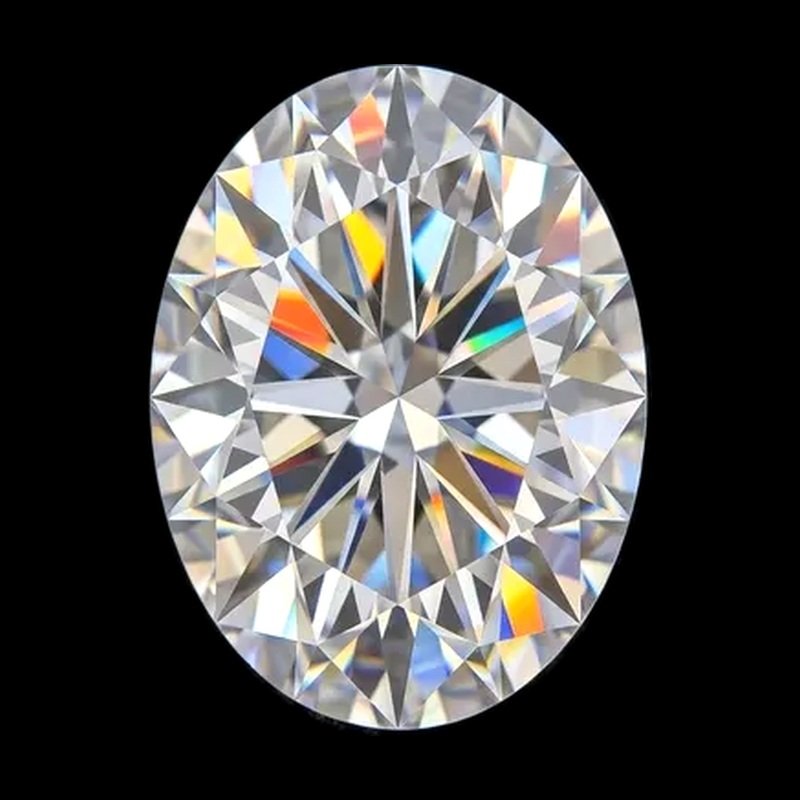
Weigh a 6.50 mm Round Color D moissanite alongside a 6.50 mm Round diamond on a milligram balance: the diamond reads 1.00 ct (200 mg), whereas the identical-width moissanite reads ~0.88–0.90 ct (176–180 mg), and a 6.50 mm cubic zirconia plunges past 1.65 ct.
Nothing is missing from the cut. That divergence demonstrates the gap between mass (carats) and diameter (millimeters), set strictly by each mineral's specific gravity relative to water.
Though silicon atoms outweigh carbon atoms (~28.09 u vs. 12.01 u), silicon's wider electron shells stretch Si–C bonds to 1.89 Å versus diamond's tight 1.54 Å C–C bond. Expanded unit-cell volume outpaces atomic mass.
Consequently, cubic carbon packs denser at 3.52 g/cm3 while 4H-SiC sits at 3.22 g/cm3. Dividing 3.22 by 3.52 gives 0.915 (~8.5% lighter for equal solids), and SiC-calibrated pavilion depths put 6.50 mm Rounds around 0.88–0.90 ct actual mass.
Selling moissanite purely by gram carat would leave a '1.00 ct' stone near ~6.7–6.8 mm—mismatching standard 6.50 mm diamond ring heads. Jewelry houses therefore standardize stones by millimeter diameter and Diamond Equivalent Weight (DEW), scaling round width as d (mm) ≈ 6.50 × ∛(DEW).
On unmounted stones, gemologists verify density via Archimedes' hydrostatic water balance or calibrated heavy liquid such as diiodomethane (SG 3.32 g/cm3): loose 4H-SiC (3.22 g/cm3) floats, whereas diamond (3.52 g/cm3) and heavy CZ (5.8 g/cm3) sink immediately.
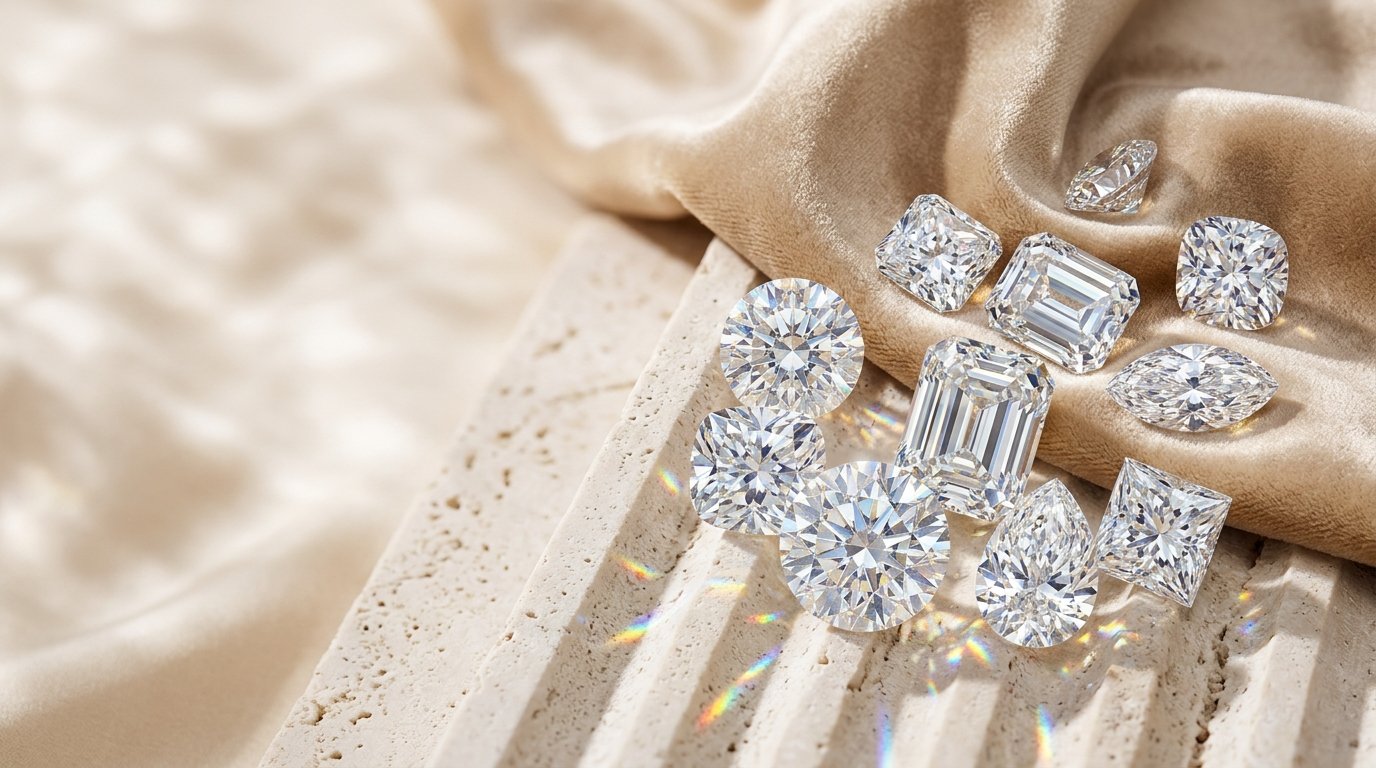
Fancy silhouettes vary sharply in face-up spread per carat: at 1.00 ct DEW, an architectural Emerald cut measures ~7.0 × 5.0 mm while an elongated Marquise stretches to ~10.0 × 5.2 mm. Checking exact millimeters guarantees proper prong basket fit.
Visual diameter vs. physical scale mass across 4H-SiC, diamond, and cubic zirconia—paired with calibrated Color D loose benchmarks.
| DEW Visual Tier | Round Diameter | 4H-SiC Actual Mass | Diamond Mass | CZ Mass | Loose Color D Benchmark |
|---|---|---|---|---|---|
| 0.50 ct DEW | 5.2 × 5.2 mm | ~0.44 – 0.46 ct | 0.50 ct | ~0.82 ct | ~$23 USD |
| 1.00 ct DEW | 6.5 × 6.5 mm | ~0.88 – 0.90 ct | 1.00 ct | ~1.65 ct | ~$32 USD |
| 1.50 ct DEW | 7.4 × 7.4 mm | ~1.32 – 1.35 ct | 1.50 ct | ~2.47 ct | ~$41 USD |
| 2.50 ct DEW | 8.8 × 8.8 mm | ~2.20 – 2.25 ct | 2.50 ct | ~4.12 ct | ~$58 USD |
| 4.50 ct DEW | 10.7 × 10.7 mm | ~3.96 – 4.05 ct | 4.50 ct | ~7.42 ct | ~$92 USD |
Shoppers unaware of specific gravity sometimes worry when a scale displays 0.89 ct on a 6.5 mm moissanite.
Because silicon carbide packs ~9–10% lighter than diamond per volume, a full 6.50 mm stone weighs ~0.89 ct while filling an exact 1.00 ct setting.
A 6.5 mm stone tipping scales past 1.60 ct exposes heavy cubic zirconia (5.8 g/cm³)—a frequent trick inside sub-$50 (under 200 PLN) silver marketplace rings bundled with inflated GRA booklets.
Watch out for sub-$50 / sub-200 PLN silver rings: The same caution applies to discount online boutiques and resellers offering sterling silver moissanite rings for less than $50 (or under 200 PLN in European markets)—almost invariably inexpensive Asian mass-market builds set with weaker warm-tinted or imprecise stones.
Choose exact millimeter proportions across discreet 0.50 ct to statement 4.50 ct DEW Color D moissanite rings crafted by Biżuteria Pola.